
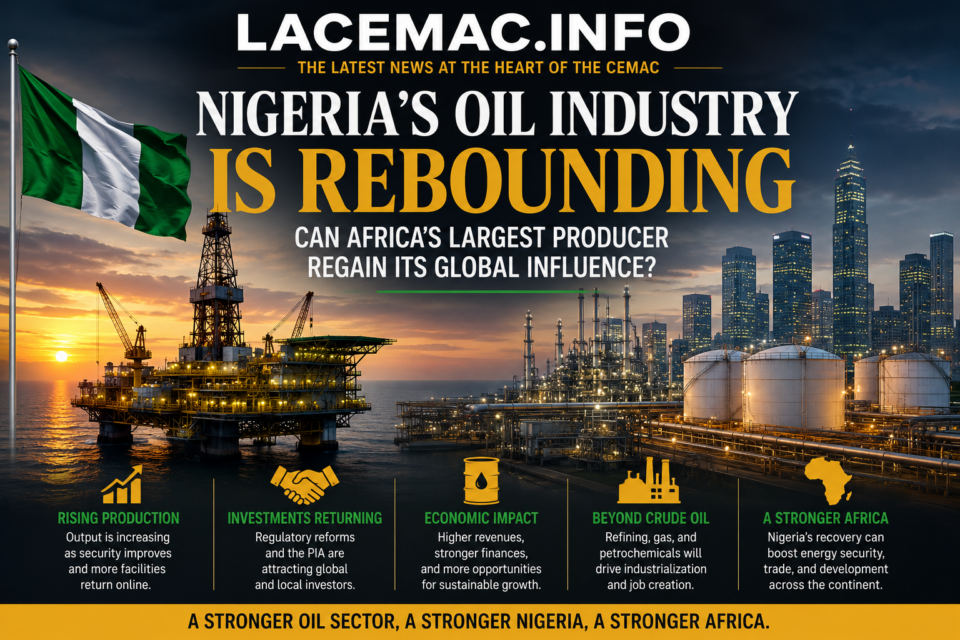

After years of declining crude oil production caused by widespread pipeline vandalism, large-scale oil theft, and chronic underinvestment, Nigeria’s petroleum industry is entering a new phase of recovery. Supported by comprehensive regulatory reforms, renewed investor confidence, and improving security conditions across key production areas, Africa’s largest oil producer is gradually restoring its position in the global energy market.
As international demand for energy remains resilient despite the accelerating transition toward low-carbon economies, Nigeria faces a defining opportunity. The country’s ability to transform its vast hydrocarbon resources into sustainable economic prosperity will not depend solely on increasing production, but on its capacity to modernize its energy sector, attract long-term investment, and strengthen its industrial competitiveness.
A Strategic Industry Emerging from Years of Crisis
For more than a decade, Nigeria’s oil sector endured one of the most challenging periods in its history. Persistent crude oil theft, sabotage of critical infrastructure, insecurity in the Niger Delta, and declining capital expenditure significantly constrained production capacity, depriving the country of billions of dollars in potential revenue.
At several points, Nigeria temporarily relinquished its long-held status as Africa’s leading crude oil producer, overtaken by competing producers whose output remained comparatively stable.
Recent developments, however, suggest that the industry is regaining momentum. Enhanced surveillance systems strengthened security operations, and closer collaboration between government institutions and industry stakeholders have contributed to a measurable increase in production. The Nigerian Upstream Petroleum Regulatory Commission (NUPRC) reports a gradual recovery in crude output as previously disrupted facilities return to operation.
Oil Remains the Foundation of Nigeria’s Economy
Despite ongoing efforts to diversify its economic base, petroleum continues to represent the cornerstone of Nigeria’s fiscal and external accounts.
Crude oil exports account for the overwhelming majority of foreign exchange earnings while providing a substantial share of government revenues. Consequently, even modest improvements in production levels can significantly strengthen public finances, stabilize the national currency, and improve macroeconomic resilience.
Higher production also enhances Nigeria’s capacity to meet its production targets within OPEC, thereby reinforcing its strategic influence in international energy markets.
Regulatory Reforms Are Restoring Investor Confidence
One of the most significant catalysts behind Nigeria’s renewed momentum has been the implementation of the Petroleum Industry Act (PIA).
Long regarded as one of the most comprehensive reforms in the country’s energy sector, the legislation seeks to modernize governance, improve fiscal transparency, streamline regulatory oversight, and establish a more predictable investment environment.
These reforms are already encouraging renewed interest from both international energy companies and indigenous producers. Several multinational corporations have reaffirmed their long-term commitment to Nigerian assets, while domestic firms are increasingly acquiring and developing oil fields previously operated by foreign operators.
This gradual transfer of strategic assets marks an important evolution in Nigeria’s ambition to expand local participation throughout the petroleum value chain.
Infrastructure Modernization Is Essential
While rising production represents an encouraging development, Nigeria’s long-term success will ultimately depend on its ability to modernize critical infrastructure.
Extensive investments are being directed toward pipeline rehabilitation, offshore production platforms, export terminals, digital monitoring technologies, and enhanced security systems designed to combat crude oil theft.
Improved infrastructure not only reduces operational risks but also lowers production costs, enhances efficiency, and strengthens Nigeria’s attractiveness as a destination for international capital.
Without sustained infrastructure development, production gains may prove difficult to maintain over the long term.
An Increasingly Competitive Global Energy Landscape
Nigeria’s recovery is unfolding against the backdrop of profound structural changes within the global energy sector.
While hydrocarbons continue to play a central role in the world economy, accelerating investment in renewable energy, technological innovation, and decarbonization policies are reshaping long-term market dynamics.
Simultaneously, major producers in the Middle East, North America, and South America continue expanding production capacity, intensifying competition for market share.
To preserve its strategic relevance, Nigeria must prioritize operational efficiency, regulatory stability, and value creation while adapting to an increasingly diversified global energy system.
Beyond Crude Oil: Building an Integrated Energy Economy
Perhaps Nigeria’s greatest opportunity lies not merely in exporting larger volumes of crude oil, but in expanding its downstream and industrial capacities.
Investments in refining, petrochemicals, fertilizers, plastics manufacturing, natural gas processing, and energy-intensive industries have the potential to generate substantial economic value while creating thousands of highly skilled jobs.
The emergence of world-class industrial infrastructure including the Dangote Refinery illustrates Nigeria’s determination to reduce dependence on imported refined petroleum products and position itself as a regional energy hub.
A stronger downstream sector would significantly enhance domestic value addition while improving energy security across West Africa.
Regional Implications for Africa
Nigeria’s resurgence extends far beyond its national borders.
As Africa’s largest economy and one of the continent’s most influential energy producers, Nigeria plays a decisive role in regional economic integration, energy security, and cross-border investment.
A revitalized Nigerian petroleum industry could stimulate infrastructure development, facilitate greater intra-African trade under the African Continental Free Trade Area (AfCFTA), and reinforce Africa’s collective position within global commodity markets.
The country’s success would therefore represent not only a national achievement but also a strategic milestone for the continent’s broader economic transformation.
LACEMAC.INFO Analysis
Nigeria’s oil sector stands at a historic inflection point.
The country possesses abundant hydrocarbon reserves, an experienced workforce, an expanding domestic market, and increasingly sophisticated industrial capabilities. Yet the future of its energy industry will depend on far more than rising crude production.
The defining challenge is to convert natural resource wealth into lasting economic prosperity through industrial diversification, technological innovation, infrastructure modernization, and human capital development.
Should Nigeria successfully consolidate its ongoing reforms while strengthening governance and enhancing investor confidence, it will not merely recover its status as Africa’s leading oil producer it could emerge as one of the world’s most dynamic and strategically significant energy economies in the decades ahead.
