
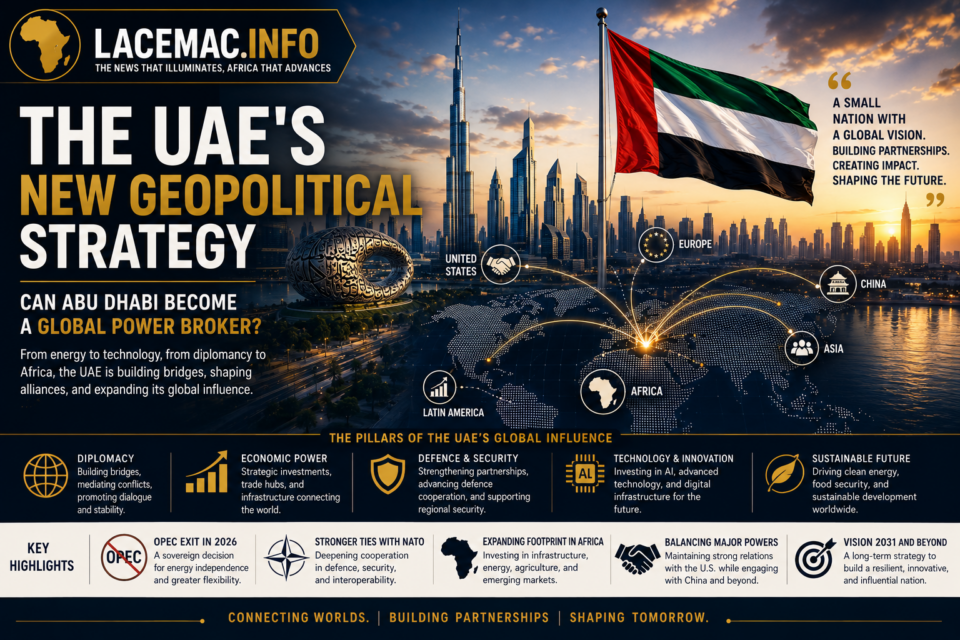

For much of its modern history, the United Arab Emirates was primarily known as a wealthy Gulf federation built on oil, trade and strategic geography. Today, that image is no longer sufficient to describe the country. Abu Dhabi is pursuing a far more ambitious role: becoming a diplomatic, technological, financial and security actor capable of influencing events well beyond the Gulf. From Washington and Beijing to Africa and Europe, the UAE is building partnerships across competing geopolitical blocs. Its growing cooperation with NATO, its expanding role in Africa and its decision to leave OPEC in 2026 all point toward a country seeking greater strategic autonomy. The question is no longer whether the UAE has influence, but whether Abu Dhabi can transform that influence into the role of a genuine global power broker.
From Gulf State to Geopolitical Actor
The UAE’s transformation has been remarkable.
For decades, its international importance was largely associated with its energy resources and its position at the crossroads of major global trade routes.
But Abu Dhabi has gradually developed a much broader strategy.
The country has invested heavily in diplomacy, infrastructure, technology, international finance and defence. Dubai has become a global commercial and logistical hub, while Abu Dhabi has increasingly positioned itself at the center of the UAE’s strategic decision-making.
This has created a distinctive model of influence.
Rather than attempting to compete directly with the world’s largest powers in terms of population or territory, the UAE has focused on becoming strategically useful to as many major actors as possible.
That approach has allowed Abu Dhabi to establish relationships with countries that do not necessarily share the same geopolitical priorities.
A Small Country with an Outsized Ambition
The UAE’s population and geographical size are modest compared with major global powers.
Yet its international footprint is considerably larger than its physical dimensions might suggest.
Its capital has developed extensive diplomatic relationships, while Emirati companies and investment institutions operate across multiple continents.
This creates an unusual form of power.
The UAE does not need to dominate another country to influence its decisions. It can instead use investment, trade, diplomacy, infrastructure, technology and strategic partnerships to create long-term relationships.
In a world increasingly characterized by competition between major powers, this kind of flexibility can be extremely valuable.
Balancing Washington and Beijing
One of the most delicate aspects of the UAE’s strategy is its relationship with the world’s two largest geopolitical powers: the United States and China.
Washington remains an essential security partner for Abu Dhabi.
The two countries cooperate in defence, technology and regional security, while the UAE has continued to strengthen its relationship with American institutions and companies.
At the same time, China has become an important economic partner for the UAE.
This creates a difficult strategic equation.
The UAE wants access to American technology, investment and security cooperation without closing the door to its economic relationship with China.
For Abu Dhabi, the objective appears to be less about choosing one side permanently than about maintaining enough strategic flexibility to protect its own interests.
That balancing act is becoming increasingly difficult as competition between Washington and Beijing intensifies.
The United States Still Matters
Despite the UAE’s growing diversification of partnerships, the American relationship remains central to its security strategy.
In 2026, Washington and Abu Dhabi continue to deepen cooperation in areas including technology, defence and artificial intelligence.
The UAE’s relationship with NATO has also been expanding. In June 2026, Emirati and NATO officials discussed strengthening cooperation, including defence supply-chain resilience, interoperability and new areas of practical collaboration.
This is significant because it demonstrates that the UAE is not simply trying to become an economic hub.
It is increasingly seeking a role within broader international security structures.
The country wants to be seen as a reliable strategic partner capable of contributing to regional and international stability.
A More Independent Energy Strategy
One of the clearest signs of Abu Dhabi’s growing strategic autonomy came in 2026.
On May 1, the UAE officially withdrew from both OPEC and OPEC+, describing the decision as a sovereign and strategic choice related to its oil-production policy and future capabilities.
The decision was particularly significant because the UAE had been one of the major producers within the organization.
Its departure reflects a broader question about how Abu Dhabi sees its future role in the global energy system.
Rather than allowing external production constraints to determine its strategy, the UAE appears increasingly interested in controlling its own production decisions and maximizing the flexibility of its national energy champion, ADNOC.
Reuters reported in August 2026 that ADNOC has subsequently adopted a more aggressive and flexible approach to global crude sales, particularly toward Asian markets.
This is not simply an economic development. It has geopolitical implications.
Energy remains one of the most important instruments of international influence, and greater control over production and exports can increase a country’s strategic flexibility.
Africa: The UAE’s Expanding Geopolitical Frontier
Perhaps nowhere is the UAE’s growing international ambition more visible than in Africa.
Abu Dhabi increasingly sees the continent as a strategic space where investment, infrastructure, logistics, energy, agriculture and technology can converge.
Ports and logistics infrastructure are particularly important.
Control or participation in strategic transport networks can create influence far beyond the value of the infrastructure itself.
Investment in African agriculture, mining and energy can also create long-term economic relationships.
At the same time, the UAE has promoted itself as a partner in Africa’s digital and energy transformation.
This strategy gives Abu Dhabi access to some of the world’s fastest-growing markets while simultaneously expanding its diplomatic and economic influence.
But Africa Also Presents Difficult Questions
The UAE’s growing presence in Africa has generated both enthusiasm and criticism.
Supporters argue that Emirati capital can help finance infrastructure, energy projects, logistics networks and economic development in countries where access to investment remains limited.
Critics, however, question the transparency and geopolitical consequences of some Emirati investments and relationships.
Recent reporting by the Financial Times has described the UAE’s African strategy as increasingly expansive, particularly in ports, mining, agriculture and energy, while also raising concerns about the country’s links to powerful political and non-state actors in some conflict-affected environments. The UAE has denied allegations that it supports the Rapid Support Forces in Sudan.
This debate will likely become increasingly important.
The more influence Abu Dhabi acquires across Africa, the greater the scrutiny surrounding how that influence is exercised.
For the UAE, economic partnerships can become geopolitical assets.
For African governments, the challenge is to ensure that these partnerships serve national development priorities while maintaining strategic autonomy.
Technology Is Becoming a Geopolitical Instrument
The UAE’s ambitions extend beyond traditional diplomacy.
Artificial intelligence has become one of the most important pillars of its long-term strategy.
Abu Dhabi increasingly views advanced technology not simply as an economic opportunity, but as a component of national power.
The country’s investments in AI, semiconductors, data infrastructure and digital technologies have attracted significant attention from Washington.
This creates another strategic balancing act.
The UAE wants access to cutting-edge American technology while maintaining relationships with China and other international technology ecosystems.
That is becoming increasingly complicated because Washington is placing greater restrictions on the transfer of advanced technologies to countries that maintain significant technological links with Beijing.
The UAE’s ability to navigate this environment could become one of the defining tests of its foreign policy.
Dubai and Abu Dhabi: Two Faces of the Same Strategy
The UAE’s international influence is also based on the complementary roles of Dubai and Abu Dhabi.
Dubai functions as the country’s global commercial face.
Its airports, ports, financial institutions, tourism sector and international business environment attract companies, investors and individuals from around the world.
Abu Dhabi, meanwhile, provides much of the country’s political, energy and strategic weight.
Together, they create an unusual combination.
Dubai brings connectivity.
Abu Dhabi brings capital and political influence.
The federation therefore possesses both a global commercial gateway and a powerful strategic center.
That combination is one of the reasons the UAE has been able to develop an international role disproportionate to its size.
A Diplomatic Strategy Built Around Flexibility
The UAE’s foreign policy increasingly appears to be guided by pragmatism.
The country can cooperate with Washington on security while maintaining important commercial relationships with Beijing.
It can strengthen ties with European institutions while deepening relationships across Asia.
It can build partnerships with African governments while maintaining a strong position in the Gulf.
This flexibility is one of Abu Dhabi’s greatest strengths.
But it is also becoming more difficult to maintain.
As geopolitical competition becomes sharper, major powers increasingly expect their partners to make clearer choices.
The UAE’s ability to remain flexible without losing the confidence of its major partners will therefore be crucial.
The Middle East Is Testing Abu Dhabi’s Strategy
The current regional environment is particularly challenging.
The UAE is located in one of the world’s most strategically sensitive regions, where energy security, maritime trade, regional rivalries and military tensions intersect.
The continuing instability around the Strait of Hormuz has demonstrated how quickly regional conflicts can affect global markets and transportation.
Reuters reported in August 2026 that disruptions around the Strait were continuing to weigh on Gulf markets and global energy expectations.
For a country whose prosperity depends heavily on international trade and connectivity, regional stability is therefore not simply a diplomatic preference.
It is a national strategic necessity.
Can Abu Dhabi Become a Global Power Broker?
The concept of a « global power broker » is different from that of a traditional superpower.
The United States and China possess enormous populations, military capabilities, technological ecosystems and domestic markets.
The UAE cannot compete with them on that scale.
But it does not need to.
A power broker operates differently.
It creates relationships with competing actors, provides capital, offers strategic infrastructure, mediates when possible and positions itself where different interests intersect.
The UAE is increasingly developing many of these characteristics.
Its influence comes from its ability to connect different worlds.
The Limits of the Model
Yet influence has limits.
The more countries and sectors a state becomes involved in, the more exposed it becomes to geopolitical risks.
Investment projects can become politically controversial.
Relationships with competing powers can create strategic contradictions.
Regional conflicts can threaten infrastructure and trade.
And a foreign policy built around flexibility can become difficult to maintain if the international system becomes increasingly polarized.
The UAE therefore faces a fundamental challenge: how to expand its influence without becoming overextended.
The Road Ahead
The next decade could determine whether the UAE’s geopolitical strategy becomes a lasting model of twenty-first-century statecraft.
If Abu Dhabi succeeds, it could become one of the world’s most influential middle powers: a country whose importance comes not from its size, but from its ability to connect capital, technology, energy, logistics and diplomacy.
Its growing presence in Africa could become a particularly important component of this strategy.
Its relationships with Washington, Beijing and European partners could provide additional strategic depth.
Its investments in artificial intelligence could give it a new source of technological influence.
And its independent energy strategy could strengthen its position in global markets.
But all of these advantages depend on one factor: strategic credibility.
LACEMAC.INFO Analysis
The UAE’s geopolitical transformation is one of the most important developments taking place in the modern Gulf.
Abu Dhabi is no longer satisfied with being a wealthy energy producer protected by larger powers.
It is attempting to become a country that can influence events, build partnerships and shape strategic conversations far beyond its borders.
Its decision to leave OPEC, its expanding relationship with NATO, its growing involvement in Africa and its push into artificial intelligence all point toward a broader ambition: greater strategic autonomy combined with global connectivity.
But the UAE’s rise also raises important questions.
Can it maintain strong relations with Washington while deepening ties with China?
Can it expand across Africa without generating excessive geopolitical resistance?
Can it protect its economic model from regional instability?
And can a relatively small state maintain such an ambitious international footprint without becoming overextended?
The answers will determine whether Abu Dhabi becomes simply an influential Gulf capital or something much more significant.
A global power does not always need to command the world. Sometimes, it only needs to become impossible to ignore.
And that may be precisely the role the UAE is trying to build for itself.
