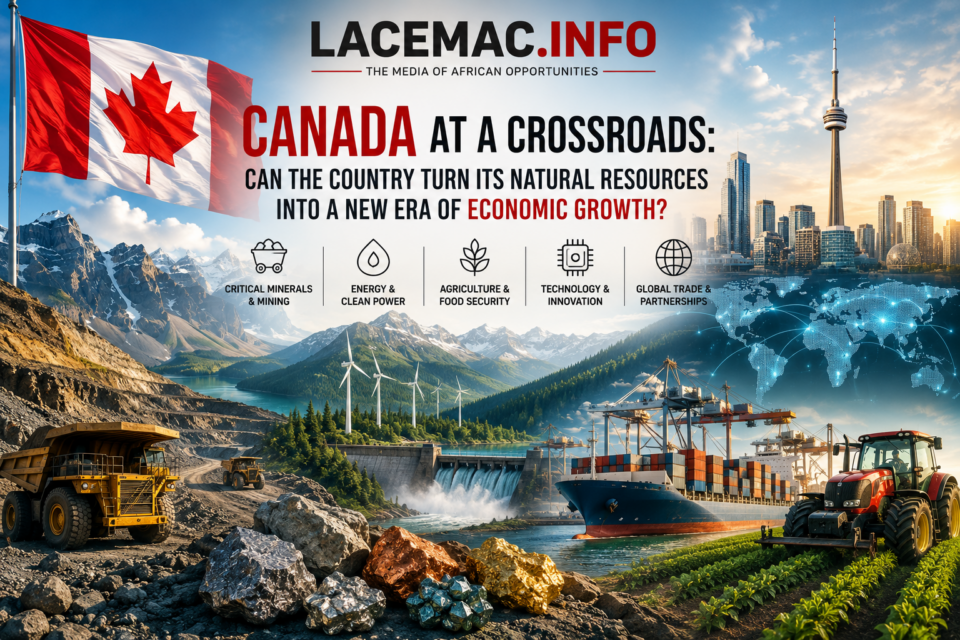

Canada has long been known for its vast territory, political stability and abundant natural resources. But the global economy is changing rapidly. Competition for critical minerals is intensifying, supply chains are being reorganized, energy security is becoming increasingly strategic, and countries are looking beyond traditional trading partners. In this changing environment, Canada faces a defining question: can it transform its extraordinary natural-resource base into a new engine of long-term economic growth while building stronger connections with markets around the world?
A Resource-Rich Country Entering a New Economic Era
Canada’s natural-resource wealth has always been one of its greatest economic assets.
From minerals and metals to energy, forests and agriculture, the country possesses resources that are increasingly important to the global economy.
But the nature of global demand is changing.
The transition toward electric vehicles, renewable energy, advanced manufacturing and digital technologies is increasing demand for minerals and materials that are essential to modern industries.
This places Canada in a potentially powerful position.
The challenge is no longer simply to extract resources.
It is to create more value from them.
Critical Minerals: Canada’s Strategic Opportunity
Few sectors illustrate Canada’s changing economic position better than critical minerals.
Canada currently produces more than 60 minerals and metals from more than 200 operating mines. In March 2026, the federal government announced more than $3.6 billion in new programs and investments aimed at strengthening Canada’s critical-minerals sector and building value chains from mining to markets.
The strategy reflects a broader reality.
Minerals are no longer simply commodities.
They have become strategic assets.
Lithium, nickel, cobalt, copper, graphite, rare earth elements and other minerals are essential to batteries, electronics, renewable-energy systems, advanced manufacturing and defence technologies.
Countries that can provide reliable supplies of these resources are increasingly important to the global economy.
Canada wants to position itself among them.
From Extraction to Value Creation
Possessing resources is only the first step.
The greater economic opportunity lies in developing the infrastructure, processing capacity, technology and industrial expertise required to transform raw materials into higher-value products.
That could mean more processing facilities, advanced manufacturing, battery supply chains and technology-intensive industries.
Such a transition could create jobs while allowing Canada to capture a larger share of the economic value generated by its resources.
It would also make the country less dependent on simply exporting raw materials.
The objective is increasingly clear: move from resource extraction toward complete value chains.
A New Geography of Global Trade
Canada’s traditional economic relationship with the United States remains fundamental.
However, the changing global economy is encouraging Ottawa to look beyond its traditional markets.
Canada’s 2026 trade strategy aims to double non-U.S. exports by 2035, while expanding commercial relationships with markets including China, India and other countries. At the same time, Canadian service exports—particularly digitally enabled services—have demonstrated greater diversification and resilience than merchandise exports.
This diversification could become one of the country’s most important economic priorities.
The question is no longer whether Canada should trade globally.
It is how effectively it can diversify its economic relationships while maintaining its existing partnerships.
The Arctic Could Become Increasingly Important
Canada’s geography provides another strategic advantage.
Its Arctic territories contain significant natural-resource potential and occupy an increasingly important position in discussions about infrastructure, sovereignty, transportation and access to northern resources.
In May 2026, the Canadian government announced more than $55 million in federal funding for two Arctic infrastructure projects designed to support critical-mineral supply chains and export diversification.
Infrastructure will therefore be crucial.
Mines cannot contribute significantly to the national economy if resources cannot be transported efficiently to processing facilities and international markets.
Roads, ports, railways, energy systems and telecommunications infrastructure could determine how much of Canada’s resource potential is actually converted into economic value.
Energy Remains a Major Advantage
Canada is also an important energy producer.
Its energy resources provide economic value today while the country simultaneously faces pressure to participate in the global transition toward cleaner energy.
This creates a complicated but potentially powerful opportunity.
Canada can use its existing energy capabilities while investing in clean technologies, renewable energy, industrial decarbonization and new forms of energy infrastructure.
The transition does not necessarily mean abandoning Canada’s resource economy.
It could mean modernizing it.
Technology Could Change the Equation
Natural resources alone will not determine Canada’s future competitiveness.
Technology will.
Artificial intelligence, automation, advanced manufacturing, digital infrastructure and scientific research could significantly increase productivity across Canada’s resource industries.
A mine equipped with advanced technologies can potentially operate more efficiently.
Agriculture can become increasingly data driven.
Energy systems can become smarter.
Manufacturing can become more automated.
The combination of natural resources and technological expertise could therefore become one of Canada’s most important competitive advantages.
The African Opportunity
There is also another dimension to Canada’s economic future that deserves greater attention: Africa.
Canada has been strengthening its economic relationships across the continent.
According to Global Affairs Canada, merchandise exports from Canada to Africa increased by 13% between 2019 and 2024, while imports from Africa increased by 109% over the same period. Canada also has investment-protection agreements with several African countries, including Cameroon, Côte d’Ivoire, Mali and Senegal.
The potential is particularly interesting in sectors such as mining, infrastructure, agriculture, education, technology and clean energy.
Canada and Africa are also connected by complementary economic strengths.
Africa possesses enormous natural resources, a rapidly growing population and expanding consumer markets.
Canada possesses expertise in mining, finance, education, technology, infrastructure and resource development.
That creates space for partnerships that could benefit both sides.
A Relationship Already Taking Shape
The relationship is not merely theoretical.
Canada’s commercial presence in Africa already includes significant activity in mining and other sectors.
In Ghana, for example, two-way merchandise trade reached approximately $483 million in 2024, while Canadian mining assets in the country were estimated at $1.1 billion in 2023.
In Côte d’Ivoire, bilateral trade reached approximately $894.5 million in 2024, with Canadian investment concentrated in areas including mining.
These examples illustrate the possibility of a broader Canada-Africa economic relationship built around investment, technology, knowledge and trade.
The Challenge: Turning Potential into Prosperity
Canada’s resource wealth gives it an advantage.
But advantages do not automatically produce prosperity.
The country must still address infrastructure needs, permitting timelines, investment requirements, technological competitiveness, workforce development and relationships with Indigenous communities.
The development of major resource projects increasingly requires collaboration among governments, industry, Indigenous communities and local stakeholders.
The Canadian government has explicitly linked its critical-minerals strategy to economic growth, job creation, environmental objectives, Indigenous reconciliation and international partnerships.
The success of this approach will depend on how effectively these priorities can be combined.
A Country with More Than One Economic Future
Canada does not have to choose between being a resource economy and becoming a technology-driven economy.
It can potentially be both.
Its natural resources can provide the foundation.
Its universities, researchers, entrepreneurs and technology companies can provide innovation.
Its infrastructure can connect resources to markets.
And its international partnerships can create new destinations for Canadian products, services and expertise.
The real opportunity lies in connecting these strengths rather than treating them as separate sectors.
LACEMAC.INFO Analysis
Canada is entering a period in which its natural resources could become more strategically important than ever before. Critical minerals, energy, infrastructure and technology are converging at a moment when countries around the world are seeking secure and diversified supply chains.
The opportunity is therefore much larger than simply increasing mining or resource exports.
Canada has the possibility of building complete economic ecosystems around its natural wealth—combining extraction, processing, technology, manufacturing, infrastructure and international trade.
At the same time, stronger economic engagement with Africa could open another dimension of this transformation. As African economies expand and demand for infrastructure, technology and investment grows, Canada has an opportunity to build partnerships that go beyond traditional aid and commodity relationships.
The central question is no longer whether Canada has the resources to compete.
It is whether Canada can transform those resources into innovation, industrial capacity, global partnerships and lasting prosperity.
If it succeeds, the country’s natural wealth could become more than an economic inheritance.
It could become the foundation of Canada’s next era of global competitiveness.
