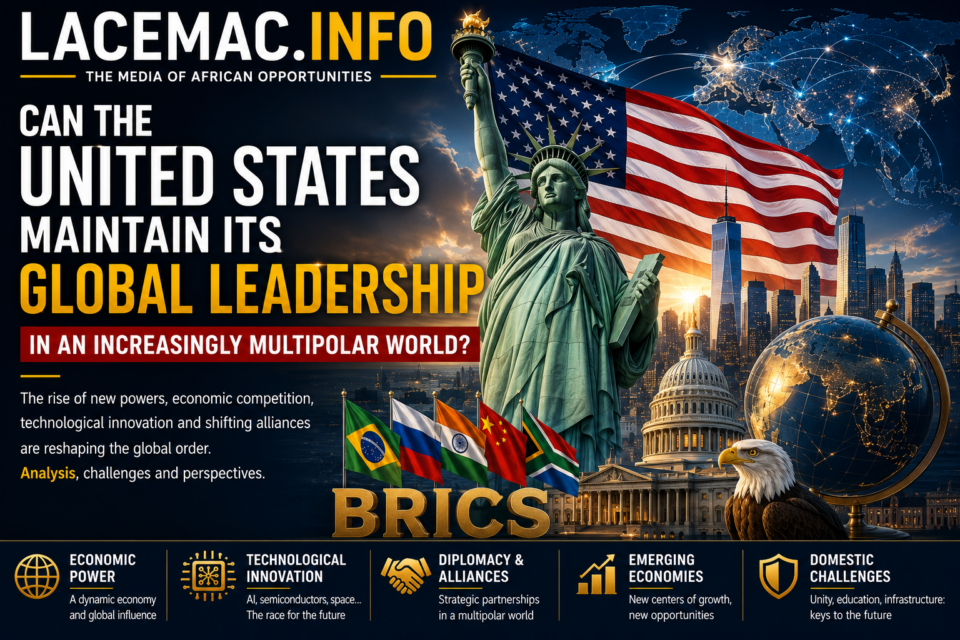

For decades, the United States has stood as the world’s leading economic, military, and technological power. Yet today’s international landscape is evolving rapidly. The rise of China, the expansion of the BRICS bloc, accelerating technological competition, and shifting geopolitical alliances are reshaping the global balance of power. Rather than signaling the end of American influence, these developments raise a more nuanced question: can the United States adapt its leadership to a world that is becoming increasingly multipolar?
A New Global Landscape
The international order is undergoing one of its most significant transformations since the end of the Cold War.
Emerging economies are gaining influence, regional organizations are becoming more assertive, and new partnerships are redefining global trade and diplomacy.
Countries such as China, India, Brazil, and several Gulf states have expanded their economic and political reach, creating a more diversified international system.
This evolving environment presents both opportunities and challenges for the United States, which has long played a central role in shaping global institutions and international cooperation.
Economic Strength Remains a Major Asset
Despite growing competition, the United States continues to possess one of the world’s largest and most dynamic economies.
Its financial markets remain highly influential, the U.S. dollar continues to serve as the world’s primary reserve currency, and American companies remain leaders in sectors such as technology, finance, aerospace, pharmaceuticals, and entertainment.
Innovation continues to be one of America’s greatest competitive advantages.
From Silicon Valley to leading research universities, the country attracts entrepreneurs, investors, and highly skilled professionals from around the world.
This ecosystem has allowed the United States to remain at the forefront of technological breakthroughs for decades.
Technology: The New Strategic Battlefield
Global leadership today is increasingly determined by technological innovation.
Artificial intelligence, semiconductor manufacturing, cybersecurity, quantum computing, biotechnology, and space exploration have become strategic priorities for major powers.
American companies continue to play a dominant role in many of these industries, investing billions of dollars in research and development.
However, competition has intensified as other countries accelerate their own technological capabilities.
Maintaining leadership will require sustained investment in education, scientific research, infrastructure, and talent development.
Diplomacy in a Multipolar Era
Military and economic power alone are no longer sufficient to shape international affairs.
Diplomatic influence increasingly depends on building partnerships, strengthening international institutions, and addressing global challenges such as climate change, public health, food security, and energy transition.
The United States continues to work closely with long-standing allies while also adapting its relationships with emerging powers.
Success in this evolving environment will depend not only on strength but also on cooperation, dialogue, and strategic flexibility.
The Growing Importance of Emerging Economies
Africa, Asia, Latin America, and the Middle East are playing an increasingly important role in global decision-making.
Rapid population growth, expanding consumer markets, abundant natural resources, and digital transformation are making these regions central to future economic development.
For the United States, strengthening partnerships with these regions offers opportunities for trade, investment, innovation, and long-term economic cooperation.
The future of global leadership may increasingly depend on the ability to build mutually beneficial relationships rather than relying solely on traditional influence.
Challenges at Home
International leadership also depends on domestic resilience.
Economic inequality, infrastructure modernization, education, healthcare, workforce development, and political polarization remain significant issues that shape America’s long-term competitiveness.
Addressing these internal challenges is essential to maintaining confidence both domestically and internationally.
Strong institutions and continued investment in human capital will remain fundamental pillars of future leadership.
Looking Ahead
The emergence of a multipolar world does not necessarily imply the decline of the United States.
Instead, it reflects a more complex international system where influence is increasingly shared among multiple actors.
America’s ability to remain a global leader will depend on its capacity to innovate, strengthen alliances, invest in its people, and adapt to changing geopolitical realities.
LACEMAC.INFO Analysis
The United States remains one of the world’s most influential nations, but global leadership in the twenty-first century is becoming increasingly collaborative rather than unilateral. Economic power, technological innovation, diplomatic engagement, and strategic partnerships will collectively determine which countries shape the future international order.
As new centers of influence continue to emerge, America’s greatest strength may not lie solely in preserving past dominance, but in its ability to evolve alongside a rapidly changing world. In a multipolar era, sustainable leadership will depend less on commanding the global system and more on helping to build one that is stable, innovative, and mutually beneficial for all.
