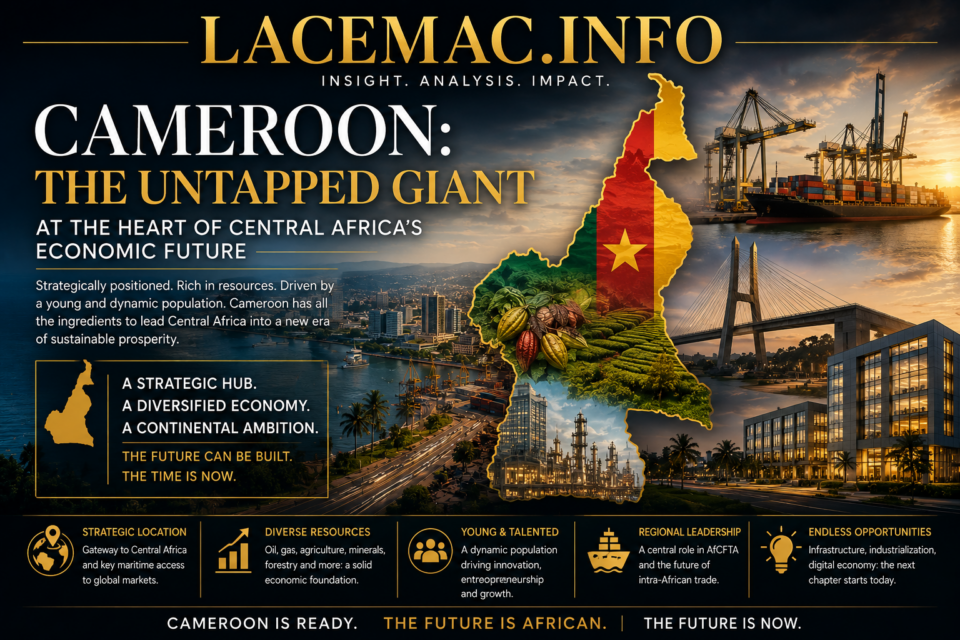

Few African countries possess an economic profile as diverse and strategically positioned as Cameroon. Stretching from the Atlantic coastline to the Sahel, the country combines vast agricultural potential, abundant natural resources, a rapidly growing population and one of Central Africa’s most important logistical corridors. Often described as « Africa in miniature » because of its extraordinary geographical and cultural diversity, Cameroon also represents a microcosm of the continent’s economic ambitions and contradictions.
Despite these undeniable strengths, the country has yet to emerge as the undisputed economic powerhouse many analysts once envisioned. While neighbouring economies remain heavily dependent on a single commodity, Cameroon benefits from one of the most diversified production bases in Sub-Saharan Africa. Yet its industrial expansion, competitiveness and regional influence continue to fall short of their immense potential.
As Africa accelerates its economic integration through the African Continental Free Trade Area (AfCFTA), Cameroon stands at a decisive crossroads. The coming decade may determine whether it finally becomes Central Africa’s leading economic engine or whether its vast opportunities remain largely unrealised.
A Strategic Position Few African Nations Can Match
Geography has always been one of Cameroon’s greatest competitive advantages.
Situated at the crossroads of West and Central Africa, the country serves as the principal maritime gateway for several landlocked nations, including Chad and the Central African Republic. Its coastline along the Gulf of Guinea provides direct access to international shipping routes, while its road and rail networks position Cameroon as a critical hub for regional commerce.
The Port of Douala has long served as one of Central Africa’s busiest commercial gateways. Complementing this infrastructure, the deep-sea Port of Kribi represents a new generation of logistics capable of accommodating larger vessels and supporting the country’s industrial ambitions.
In an era where global supply chains increasingly value efficiency and regional connectivity, logistics may become one of Cameroon’s most valuable strategic assets.
An Economy Built on Diversity Rather Than Dependence
Unlike many resource-dependent economies, Cameroon benefits from an unusually diversified economic structure.
Agriculture remains one of the country’s largest employers, with cocoa, coffee, bananas, cotton, rubber and palm oil contributing significantly to exports.
Its subsoil contains oil, natural gas, bauxite, iron ore, limestone, cobalt and numerous other mineral resources that remain only partially exploited.
Forestry continues to represent another major pillar of the national economy, while manufacturing, telecommunications, financial services and construction have gradually expanded over recent years.
This diversification offers Cameroon a considerable advantage.
Countries that depend excessively on a single commodity often experience severe economic volatility whenever international prices fluctuate. Cameroon, by contrast, possesses multiple sources of economic activity capable of supporting long-term growth.
Industrialisation: The Missing Link
Despite its economic diversity, Cameroon continues to export a substantial proportion of its natural wealth in raw or minimally processed form.
Cocoa beans, timber and agricultural commodities still generate significant export revenues without creating the full industrial value that local transformation could provide.
This challenge is not unique to Cameroon.
Across Africa, the inability to process natural resources domestically has limited industrial development and reduced job creation.
For Cameroon, industrialisation represents the decisive factor that could transform economic potential into sustainable prosperity.
Expanding agro-processing, food manufacturing, mineral refining and light industry would not only increase export earnings but also strengthen domestic supply chains and create thousands of skilled jobs.
A Young Population Represents Both an Opportunity and a Responsibility
One of Cameroon’s greatest assets is its demographic profile.
With a predominantly young population, the country possesses a workforce capable of driving innovation, entrepreneurship and technological development for decades to come.
However, demographic growth alone does not guarantee economic success.
The challenge lies in creating sufficient employment opportunities, improving education systems and equipping young people with the digital and technical skills increasingly demanded by modern industries.
If successfully harnessed, Cameroon’s human capital could become one of its most valuable economic resources.
Foreign Investment Is Watching Closely
International investors are increasingly evaluating African economies according to three fundamental criteria: political stability, infrastructure quality and market potential.
Cameroon performs relatively well on the third criterion.
Its sizeable domestic market, strategic geographic position and diversified economy continue to attract interest from investors seeking long-term opportunities in Central Africa.
Major infrastructure projects, expanding energy investments and improvements in transport networks demonstrate the country’s ambition to strengthen its competitiveness.
Nevertheless, investors continue to emphasise the importance of regulatory efficiency, administrative transparency and an improved business environment as essential conditions for accelerating investment flows.
The AfCFTA Could Redefine Cameroon’s Regional Role
The implementation of the African Continental Free Trade Area may represent one of the most significant economic opportunities in Cameroon’s modern history.
As barriers to intra-African trade gradually decline, countries with strong transport infrastructure and diversified production are likely to become regional commercial centres.
Cameroon possesses many of these characteristics.
Its ports, transport corridors and manufacturing potential position the country to become a major distribution and industrial hub serving both the CEMAC region and broader African markets.
Success, however, will depend upon the country’s ability to strengthen competitiveness while modernising infrastructure and simplifying cross-border trade.
Beyond Natural Resources: Building a Knowledge Economy
The future of economic leadership will not be determined solely by natural resources.
Innovation, digital transformation and technological capability are becoming equally decisive.
Cameroon’s expanding technology ecosystem, dynamic entrepreneurial community and growing digital economy illustrate the country’s capacity to participate in Africa’s knowledge-based transformation.
Supporting start-ups, encouraging research and strengthening digital infrastructure could enable Cameroon to diversify beyond traditional sectors while attracting higher-value investment.
Economic competitiveness in the twenty-first century increasingly depends upon ideas as much as commodities.
LACEMAC.INFO Analysis
Cameroon is not a country lacking economic opportunities.
On the contrary, few African nations combine such a strategic geographic location, abundant natural resources, economic diversification and demographic dynamism within a single national economy.
The real question is no longer whether Cameroon possesses the potential to become Central Africa’s leading economic power.
Its potential is already evident.
The greater challenge lies in transforming comparative advantages into lasting competitive advantages through industrialisation, institutional reforms, investment in infrastructure, human capital development and deeper regional integration.
As global investors increasingly look toward Africa for future growth, Cameroon finds itself in a uniquely favourable position. Whether it succeeds will ultimately depend not on the wealth beneath its soil, but on the policies, institutions and long-term vision that shape the nation’s economic transformation over the coming decades.
