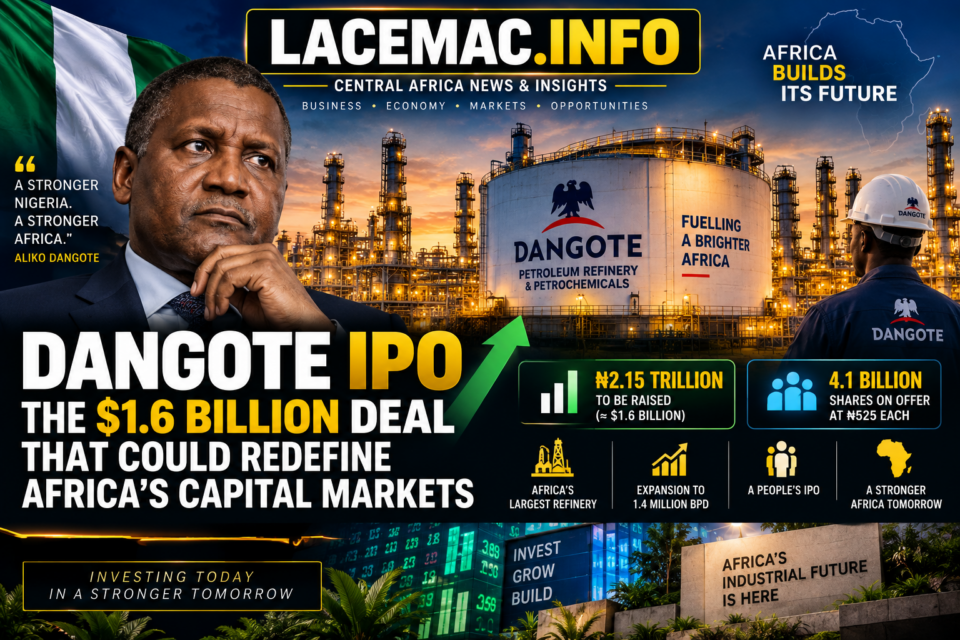

Nigeria has opened what could become one of the most consequential chapters in the history of African capital markets. On September 14, 2026, Dangote Petroleum Refinery and Petrochemicals officially launched its initial public offering, offering 4.1 billion shares at ₦525 each and seeking to raise as much as ₦2.15 trillion — approximately $1.6 billion. The transaction is being positioned as Africa’s largest-ever public share offering and gives ordinary investors an opportunity to acquire a stake in one of the continent’s most strategically important industrial assets. Yet beneath the headline numbers lies a much larger story: the attempted transformation of Africa’s largest refinery into a publicly owned financial powerhouse, the emergence of a deeper Nigerian investment culture, and a potentially defining test of whether African capital markets can finance African industrial ambitions at scale.
A Landmark Moment for African Finance
The Dangote IPO is not simply another stock-market listing.
It represents an attempt to bring one of Africa’s most ambitious industrial projects into the public capital markets at an extraordinary scale.
Investors are being offered 4.1 billion ordinary shares at ₦525 per share, implying a potential fundraising of approximately ₦2.15 trillion. At full subscription, the transaction would raise around $1.6 billion, while valuing Dangote Petroleum Refinery at roughly $47.6 billion.
The public offer opened on September 14 and is scheduled to remain available until October 13, 2026. Trading of the shares is expected to begin later in November, meaning the market has only just entered the first stage of what promises to be an extraordinary financial experiment.
The symbolism is difficult to overlook.
For decades, Africa’s largest infrastructure projects have frequently relied upon foreign capital, sovereign financing, international development institutions or commercial bank debt. Dangote is attempting something different: mobilizing a substantial pool of African capital around an African-owned industrial asset of global significance.
That distinction matters.
The Asset Behind the IPO
At the centre of the operation stands the Dangote Petroleum Refinery, an industrial complex that has already transformed Nigeria’s energy landscape.
Built over approximately a decade at a cost of around $20 billion, the refinery began operations in 2024 and has a current processing capacity of approximately 700,000 barrels of crude oil per day. It is widely regarded as Africa’s largest refinery and one of the world’s largest single-train refining facilities.
Its strategic significance goes far beyond the balance sheet of Dangote Industries.
Nigeria is one of Africa’s largest crude-oil producers, yet for years the country remained heavily dependent on imported refined petroleum products because of inadequate domestic refining capacity.
The contradiction was extraordinary: a major oil producer exporting crude while importing fuel.
Dangote’s refinery was built precisely to challenge that structural imbalance.
Its emergence gives Nigeria the possibility of retaining more value within its own economy, reducing dependence on imported refined products and potentially transforming the country from a predominantly crude-exporting economy into a major regional refining and petrochemical hub.
That is why the IPO matters beyond the interests of its shareholders.
Why Dangote Is Going Public
The most obvious question is straightforward: why does Dangote need the public markets now?
The answer lies partly in the scale of its next ambition.
The refinery is planning an enormous expansion programme that could require approximately $14.3 billion, with the objective of increasing processing capacity from 700,000 barrels per day to approximately 1.4 million barrels per day by 2029.
That would place the facility on an entirely different scale.
The IPO therefore needs to be understood not merely as a liquidity event, but as part of a broader capital strategy.
Dangote is effectively telling the market that the refinery has moved beyond the construction phase and into a new era: one characterized by expansion, increased production, deeper integration into global energy markets and potentially greater access to institutional and international capital.
In this sense, the IPO is not the conclusion of the refinery story.
It may be the beginning of its second act.
A Business Already Generating Serious Cash
The timing of the IPO is particularly striking because Dangote Refinery enters the market after a dramatic improvement in its financial performance.
During the first half of 2026, the refinery reportedly generated more than $13 billion in revenue and approximately $1.82 billion in net profit, reversing a loss of roughly $476 million recorded during the corresponding period of the previous year.
That turnaround is one of the most important elements investors will be studying.
An IPO of this magnitude cannot rely indefinitely on symbolism, patriotism or the reputation of its founder.
Ultimately, public markets demand numbers.
Investors will want to understand the sustainability of margins, crude-oil procurement costs, refining spreads, working-capital requirements, debt obligations, capital expenditure and the ability of the refinery to maintain profitability once extraordinary market conditions normalize.
The question is no longer simply whether Dangote Refinery can operate.
The question is whether it can consistently generate enough value to justify its extraordinary valuation.
The ₦525 Question
At ₦525 per share, the IPO places a clear price on access to Dangote Refinery.
For retail investors, the minimum subscription is only 10 shares, equivalent to ₦5,250, allowing participation at a relatively low entry point compared with many major institutional offerings.
That accessibility is deliberate.
Dangote has presented the transaction as a kind of “people’s IPO”, seeking to broaden ownership beyond traditional institutional investors and give ordinary Nigerians the opportunity to participate directly in one of the country’s most important industrial enterprises.
It is a powerful proposition.
Imagine a refinery that has become central to Nigeria’s energy security being partly owned by thousands or potentially millions of Nigerian investors.
That could fundamentally alter the relationship between citizens, corporations and the Nigerian capital market.
Yet accessibility should never be confused with guaranteed profitability.
An affordable share price does not necessarily mean an undervalued company.
The market will ultimately determine whether the valuation is justified.
A $47 Billion Valuation Under the Microscope
According to Reuters, the IPO implies a valuation of approximately $47.6 billion for Dangote Refinery.
That is an extraordinary figure for an African industrial company.
It also creates a formidable burden of expectations.
A company valued at that level is no longer judged merely by whether it is strategically important. Investors will expect sustained profitability, disciplined capital allocation, competitive margins and credible expansion prospects.
The market will therefore scrutinize every element of the business.
How much crude can the refinery secure domestically?
How efficiently can it operate at full capacity?
How resilient are its margins when international refining spreads weaken?
Can its export strategy withstand competition from other major refineries?
And perhaps most importantly: can Dangote successfully deploy billions of additional dollars without destroying shareholder value?
These are the questions that will determine the long-term success of the IPO.
The $14.3 Billion Expansion
Perhaps the most ambitious element of the entire story is what Dangote intends to do after the IPO.
The company plans to invest approximately $14.3 billion in an expansion programme designed to double refinery capacity to 1.4 million barrels per day by 2029.
This is not a marginal expansion.
It represents a major escalation of Dangote’s industrial footprint.
If successfully executed, the refinery would become one of the most consequential refining centers anywhere in the world, dramatically increasing Nigeria’s potential role as a supplier of refined petroleum products.
The expansion could also reinforce the country’s position as a regional energy hub.
West African markets currently depend on a complex network of imports and international suppliers. A refinery of this scale gives Nigeria the possibility of supplying neighbouring economies with refined products from within the region.
That could alter trade flows across West Africa.
Dangote’s Ambition Is Becoming Regional
The broader Dangote strategy extends beyond the Nigerian domestic market.
The refinery already exports refined products to markets across Africa, while the group has continued to explore additional industrial opportunities beyond Nigeria. Reuters has reported that Dangote is also considering projects including a refinery in Kenya.
This suggests that the refinery is increasingly being positioned not simply as a Nigerian asset, but as part of a broader African industrial strategy.
That distinction is important.
If Dangote can establish a network of large-scale energy and petrochemical assets across different African markets, the group could gradually evolve from being one of Africa’s largest conglomerates into a more integrated continental industrial platform.
The IPO could provide the financial architecture for that next phase.
A New Chapter for Nigeria’s Capital Market
There is another reason why the Dangote IPO deserves close attention.
It could become a defining moment for the Nigerian Exchange and the country’s broader capital-market ecosystem.
A successful transaction of this magnitude would demonstrate that Nigeria can mobilize substantial domestic savings around a world-class industrial company.
That could encourage other African corporations to consider public listings rather than relying exclusively on bank financing, private equity or foreign investors.
The implications could be significant. More listings could deepen market liquidity.
More retail participation could broaden financial inclusion. More institutional investment could improve capital allocation.
And more successful African IPOs could gradually reduce the continent’s dependence on external sources of financing.
In other words, Dangote may be testing more than investor appetite.
He may be testing the capacity of African capital itself.
The Geopolitical Dimension
Energy security has become an increasingly strategic issue worldwide.
Wars, sanctions, disruptions in global supply chains and instability in major producing regions have demonstrated how vulnerable energy markets can become when refining capacity is concentrated in a limited number of locations.
Nigeria therefore has a strategic interest in building domestic refining capacity.
Dangote Refinery potentially gives Africa’s largest economy greater control over an essential part of its energy supply chain.
And if capacity eventually reaches 1.4 million barrels per day, the refinery could possess an influence extending far beyond Nigeria’s borders.
For West Africa, that could mean shorter supply chains, greater regional energy integration and potentially reduced dependence on refined products shipped from outside the continent.
The refinery is consequently becoming both a corporate asset and a piece of Nigeria’s economic sovereignty architecture.
But Size Alone Does Not Guarantee Success
The excitement surrounding the IPO should not obscure the risks. Oil refining is inherently cyclical.
Margins fluctuate. Crude prices move unpredictably. Geopolitical shocks can radically alter supply and demand.
Currency volatility can affect financing and imported equipment. And the enormous capital expenditure required for future expansion creates additional execution risk.
There is also the question of governance.
Once a company enters the public market, minority shareholders expect transparency, accountability and clear disclosure regarding how capital is deployed.
Dangote will therefore face a new kind of scrutiny. The public markets will not only provide capital.
They will also impose discipline.
THE LACEMAC.INFO ANALYSIS
The Dangote IPO should not be reduced to the headline figure of $1.6 billion.
Its real significance lies in what it represents.
For years, Africa’s industrialization debate has revolved around one fundamental problem: the continent possesses enormous resources and a vast consumer market, yet struggles to mobilize sufficient long-term capital to finance industrial transformation.
Dangote is attempting to answer that problem from within the continent.
The refinery was built with African ambition, in Africa, for an African market. It is now being brought to the public markets in an effort to mobilize additional capital for its next phase of expansion.
That is precisely what makes this IPO so fascinating.
If successful, it could establish a new precedent in which African savings finance African infrastructure, African industries and African champions.
The implications could extend far beyond Dangote. Mining companies could follow.
Telecommunications groups could follow. Energy companies could follow. Infrastructure developers could follow.
And perhaps, over time, Africa could begin to develop deeper domestic capital markets capable of financing projects that currently depend heavily on foreign capital.
But there is a second side to the story.
The IPO also represents a test of whether the market can separate industrial prestige from investment value.
Dangote Refinery is undeniably strategic. It is undeniably enormous. And its financial performance has improved dramatically. But investors are not buying a symbol. They are buying shares in a company.
That means valuation, profitability, governance, capital expenditure and future cash flows ultimately matter more than the excitement surrounding the transaction.
The Beginning of a New Investment Culture?
Perhaps the most fascinating dimension of the IPO is the retail-investor component.
By lowering the entry threshold to ₦5,250 for the minimum 10-share subscription, Dangote is attempting to make participation accessible to ordinary Nigerians.
That could have consequences far beyond this particular transaction.
If large numbers of Nigerians become shareholders, the psychological relationship between the public and the country’s corporate sector could change.
A refinery would no longer simply be something Nigerians read about.
It would become an asset in which ordinary citizens could potentially hold an economic interest.
That is powerful. It could encourage a new generation to understand equities, dividends, corporate earnings and long-term investing.
But it also carries an obligation: investors must understand that shares can rise and fall, and that participation in an IPO is not a guarantee of profit.
The Global Market Is Watching
The scale of the transaction means international investors are watching Nigeria closely.
The July private placement had already attracted approximately $2.5 billion, including institutional investors such as the Africa Finance Corporation.
The IPO now takes the story one step further by opening the company to a broader public investor base.
And Dangote’s ambitions appear to extend even further.
Reuters reported that the group is considering the possibility of eventually listing the refinery business in the United States, potentially within the next three to four years.
If such a move materialises, Dangote Refinery could evolve from an African IPO story into a genuinely global capital-markets story.
What Happens Next?
The immediate focus will be subscription levels.
The market will want to know whether investors will absorb the full offering, whether retail participation meets expectations and how the final allocation will be structured.
Then comes the next major milestone: the expected commencement of trading later in November.
That will provide the market with its first real verdict on the valuation.
The IPO price is ₦525.
The market price after listing will tell us what investors actually believe the company is worth.
That distinction could become one of the most fascinating financial stories of the year.
Conclusion: More Than an IPO
The Dangote Refinery IPO is historic because of its size. It is important because of the strategic asset behind it.
But it could become truly transformative because of what it says about the future of African finance.
At stake is not merely ₦2.15 trillion.
At stake is a broader proposition: that African corporations can build at global scale, that African investors can finance African industrial champions, and that African capital markets can evolve from relatively shallow exchanges into powerful engines of industrial growth.
Dangote has already built the refinery. Now comes the harder challenge.
Convincing the market that the next chapter of the Dangote story belongs not only to one of Africa’s most powerful entrepreneurs, but also to the investors willing to bet on the continent’s industrial future.
And as the subscription window progresses, one question will dominate the Nigerian market:
Will Africa buy into Dangote’s next great industrial ambition?
