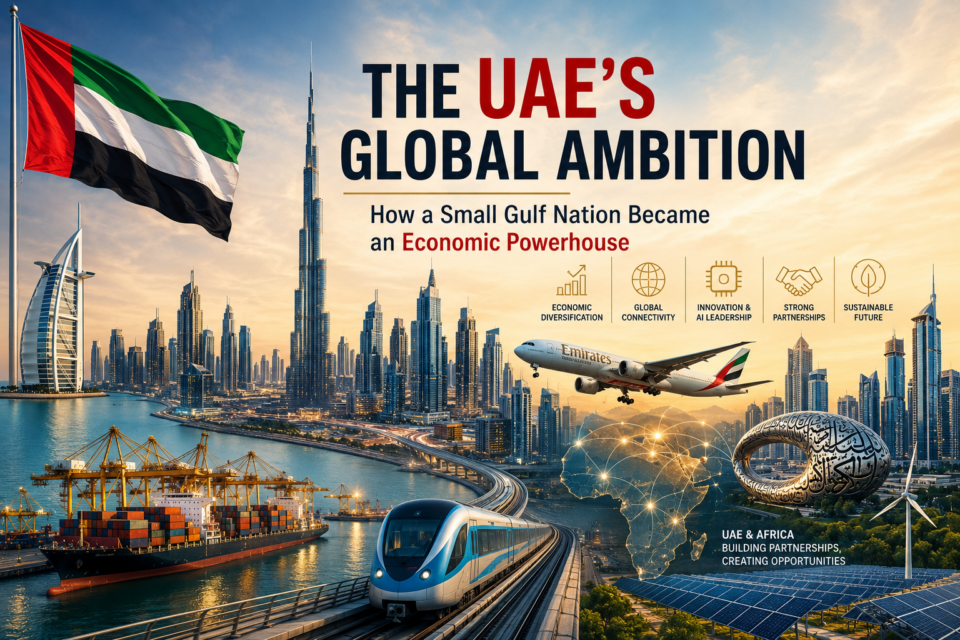

In just a few decades, the United Arab Emirates has transformed itself from a regional oil producer into one of the world’s most recognizable economic and commercial hubs. Dubai has become synonymous with global tourism, aviation, finance and real estate, while Abu Dhabi has emerged as a major center for investment, energy and technology. Yet the UAE’s ambition extends far beyond its current achievements. Through large-scale investments, economic diversification, artificial intelligence, logistics and international partnerships, the country is attempting to build an economy capable of competing globally long after the age of oil.
From Oil Wealth to Economic Diversification
The UAE’s economic story began with oil.
Hydrocarbon revenues provided the financial foundation for the development of modern infrastructure, cities, transportation networks and public institutions.
But the country’s leadership recognized early that long-term prosperity could not depend entirely on hydrocarbons.
The strategy that followed was fundamentally different.
Instead of abandoning its natural-resource wealth, the UAE used it as a foundation for building new sectors. Tourism, aviation, finance, logistics, real estate, technology and renewable energy have progressively become important pillars of the country’s economic identity.
Today, these sectors form an increasingly important part of the country’s economic landscape.
The UAE’s « We the UAE 2031 » vision explicitly aims to double national GDP from AED 1.49 trillion to AED 3 trillion, increase non-oil exports to AED 800 billion and raise foreign trade to AED 4 trillion.
Dubai: A City Designed for Global Business
Few places illustrate the UAE’s economic transformation better than Dubai.
The city has deliberately positioned itself as a meeting point between Europe, Asia, Africa and the Middle East.
Its airports, ports, financial centers, free zones and logistics infrastructure have helped create an environment designed around international business.
Dubai’s success is not simply the result of its skyscrapers.
Behind the skyline lies an economic strategy focused on connectivity.
A company can establish operations in Dubai and use the city as a gateway to multiple international markets.
This geographical advantage has become one of the UAE’s most valuable economic assets.
Aviation as a Strategic Advantage
The UAE understood something fundamental about globalization: connectivity creates economic power.
Its aviation sector has therefore become an important component of the country’s international positioning.
Dubai and Abu Dhabi have developed major international aviation networks connecting the Gulf with Asia, Europe, Africa and the Americas.
This connectivity supports tourism, trade, business travel and investment.
It also strengthens the UAE’s position as a global transit hub.
The result is a powerful economic cycle: better connectivity attracts businesses, businesses attract talent and investment, and investment strengthens the country’s international connectivity.
Abu Dhabi and the Rise of Global Investment
While Dubai became famous for entrepreneurship, tourism and international commerce, Abu Dhabi developed another powerful economic model.
The emirate has used its substantial financial resources to build investment capabilities extending far beyond the UAE.
Its strategy reflects a broader transformation of the Gulf: sovereign capital is increasingly being used not simply to preserve wealth, but to participate in the industries that will shape the global economy.
Technology, infrastructure, energy, healthcare, manufacturing and artificial intelligence are becoming increasingly important areas of interest.
This gives the UAE an unusual combination of strengths: capital, infrastructure, strategic geography and political ambition.
Artificial Intelligence: The Next Frontier
Perhaps the most significant element of the UAE’s long-term strategy is its push into artificial intelligence.
The country increasingly sees AI not simply as a technology sector, but as an economic and geopolitical asset.
The UAE has been investing in digital infrastructure, research, talent and partnerships designed to establish itself as a major player in the global AI ecosystem.
Its ambition also extends beyond its borders.
In 2025, the UAE announced a $1 billion « AI for Development » initiative focused on supporting artificial-intelligence projects across African countries. The initiative includes applications in areas such as education, agriculture and infrastructure.
This illustrates an important aspect of the UAE model: technological ambition is increasingly being combined with international economic diplomacy.
The UAE and Africa: A Growing Economic Relationship
For LACEMAC.INFO, this dimension is particularly important.
The UAE has been expanding its economic engagement with Africa through investment, infrastructure, renewable energy, logistics, agriculture and digital transformation.
The UAE’s Ministry of Foreign Affairs describes trade and investment in Africa as a strategic priority, with renewable energy and food security identified as important areas for cooperation.
The relationship is becoming increasingly institutionalized.
In January 2026, the UAE and the African Union Commission reaffirmed their commitment to strengthening cooperation around trade, investment, infrastructure, digital transformation and sustainable development.
In April 2026, discussions between the UAE and the AfCFTA Secretariat focused specifically on infrastructure, digital infrastructure and investment cooperation.
For Africa, this creates opportunities for capital, technology and infrastructure.
For the UAE, Africa represents a continent with enormous markets, natural resources, young populations and long-term growth potential.
Ghana: A Concrete Example
The UAE’s growing relationship with Africa can also be seen in Ghana.
In 2025, Ghana and the UAE discussed deeper cooperation in renewable energy, artificial intelligence, education, healthcare, aviation and investment. The two countries also explored opportunities in infrastructure, agro-processing, technology and sustainable development.
In May 2026, the leaders of the two countries discussed strengthening energy cooperation, including potential UAE investment in oil and gas storage facilities in Ghana, alongside opportunities in renewable energy, technology and artificial intelligence.
Such partnerships demonstrate how the UAE’s global strategy increasingly connects Gulf capital with African economic opportunities.
Renewable Energy and the Post-Oil Economy
There is an apparent contradiction at the heart of the UAE’s economic transformation.
The country became wealthy through hydrocarbons while simultaneously positioning itself as an important participant in the global energy transition.
Rather than viewing these two realities as mutually exclusive, the UAE has sought to participate in both.
Its strategy includes investments in renewable energy, clean technologies and green infrastructure.
Its engagement with Africa reflects this approach as well.
The UAE has highlighted a $4.5 billion Africa Green Investment Initiative, launched during its COP28 presidency, with an objective of supporting clean-energy capacity and sustainable industrial development across Africa.
This represents a broader shift in the country’s economic diplomacy: energy is no longer only about exporting hydrocarbons. It is increasingly about financing and participating in the energy systems of the future.
Trade as the Foundation of Global Influence
The UAE’s economic model is ultimately built around one central idea: becoming indispensable to international commerce.
The country has actively pursued relationships with major economic regions.
The European Union, for example, was the UAE’s second-largest global trade partner in 2024, with $67.6 billion in non-oil trade between the two sides.
The UAE’s geographic position gives it another advantage.
It sits at the intersection of major commercial routes linking Asia, Europe, Africa and the Middle East.
This allows the country to position itself not necessarily as the largest market, but as one of the most strategically connected.
A New Model of Economic Power
The UAE’s rise offers an interesting lesson.
Economic power in the twenty-first century is not determined solely by population size or territorial scale.
A country can increase its influence by combining capital, infrastructure, technology, connectivity and international partnerships.
This combination has become one of the defining features of the UAE’s development model.
The country has sought to create an ecosystem in which global companies, investors, entrepreneurs and governments have reasons to establish relationships with it.
The Challenges Behind the Success
The UAE’s transformation should not, however, be viewed without acknowledging the challenges.
Economic diversification requires continuous investment.
Global competition is becoming stronger.
Other countries are developing their own financial centers, logistics hubs and technology ecosystems.
The transition to a knowledge-based economy also requires highly skilled talent, research capacity and educational development.
Furthermore, the country’s international ambitions expose it to geopolitical and economic risks beyond its borders.
Maintaining its position will therefore require constant adaptation.
The Road Ahead
The next stage of the UAE’s development may be very different from the one that made Dubai famous.
The future could be increasingly defined by artificial intelligence, advanced manufacturing, clean energy, financial technology, logistics, digital infrastructure and international investment.
The country’s own 2031 strategy makes clear that its ambitions extend beyond traditional economic sectors, with human capital, innovation, infrastructure and international partnerships at the center of its long-term vision.
The objective is not simply to remain wealthy.
It is to remain relevant.
LACEMAC.INFO Analysis
The UAE’s transformation is one of the most remarkable economic stories of the modern Middle East.
Its success did not come simply from possessing oil.
It came from using the wealth generated by natural resources to build infrastructure, attract international businesses, develop global connections and invest in sectors capable of creating new sources of economic value.
The country’s next challenge is even more ambitious: transforming itself into a global hub for technology, artificial intelligence, finance, clean energy and international investment.
Its growing relationship with Africa could become an important part of that future.
As African economies expand, the UAE is increasingly positioning itself as a bridge between African opportunities and global capital, technology and expertise.
The story of the UAE therefore offers a broader lesson for emerging economies around the world:
Natural resources can create wealth. But strategic vision, human capital, infrastructure and innovation determine what a country does with that wealth.
And for the UAE, the ambition is no longer simply to build one of the world’s most successful cities.
It is to build one of the world’s most influential economies.
