
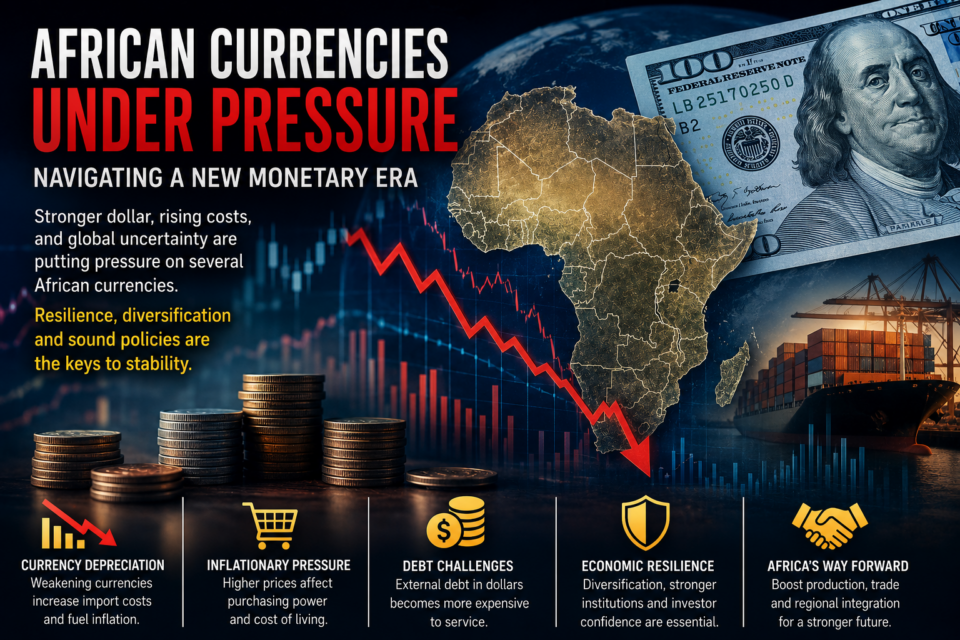

Currency markets rarely dominate newspaper headlines, yet they often determine the trajectory of entire economies. From Accra to Lusaka and from Lagos to Nairobi, renewed pressure on several African currencies has once again highlighted the continent’s vulnerability to global financial shocks. While exchange rate fluctuations may appear to be a technical concern reserved for economists and central bankers, they directly influence inflation, investment, trade competitiveness and the purchasing power of millions of households.
The latest developments in African foreign exchange markets are therefore far more than a temporary financial adjustment. They reflect the emergence of a new global monetary environment in which access to foreign capital, geopolitical uncertainty and the enduring dominance of the U.S. dollar continue to shape Africa’s economic future. Recent market data indicate renewed pressure on Ghana’s cedi and Zambia’s kwacha, while Kenya’s shilling remains comparatively stable and Nigeria’s naira has been supported by central bank interventions.
The Dollar Remains the World’s Most Powerful Economic Instrument
Despite growing discussions surrounding de-dollarisation and the emergence of alternative payment systems, the U.S. dollar continues to occupy an unrivalled position within the international financial system.
Most globally traded commodities including oil, natural gas, cocoa, gold and copper—are priced in dollars. Sovereign debt is largely denominated in the same currency, while international investors continue to regard the dollar as the world’s primary reserve asset.
For African economies, this reality creates an unavoidable dependency.
Whenever global demand for dollars rises or investors seek safer financial assets, African currencies inevitably face downward pressure, irrespective of domestic economic fundamentals.
This structural imbalance explains why exchange-rate volatility remains one of the continent’s most persistent macroeconomic challenges.
Why Several African Currencies Are Once Again Under Pressure
The current depreciation affecting a number of African currencies stems from a combination of domestic and international factors.
In Ghana, sustained corporate demand for dollars particularly from energy companies and import-dependent businesses continues to exceed available foreign currency supply. Although future IMF disbursements may provide temporary relief, market analysts expect continued pressure on the cedi.
In Zambia, political uncertainty ahead of national elections has encouraged businesses to increase their demand for foreign currency, placing additional strain on the kwacha.
Nigeria presents a different scenario.
Although structural challenges remain, interventions by the Central Bank have helped preserve short-term stability in the foreign exchange market, preventing sharper depreciation of the naira.
Meanwhile, Kenya has demonstrated comparatively greater resilience, supported by consistent remittance inflows from its diaspora and relatively balanced foreign exchange earnings.
These contrasting situations illustrate a broader reality: African currencies are increasingly influenced by each country’s capacity to generate stable foreign exchange inflows rather than by global market conditions alone.
Beyond Exchange Rates: The Real Economic Consequences
Currency depreciation affects far more than financial markets.
For businesses, weaker national currencies increase the cost of importing machinery, industrial equipment, pharmaceuticals, technology and fuel.
For governments, they raise the cost of servicing external debt contracted in foreign currencies.
For households, they often translate into higher food prices, more expensive transportation and declining purchasing power.
Imported inflation therefore remains one of the principal threats to macroeconomic stability across many African economies.
Central banks consequently face a delicate balancing act.
Increasing interest rates may help stabilise exchange rates and contain inflation, yet tighter monetary policy can simultaneously reduce private investment, slow business activity and weaken economic growth.
A Test of Africa’s Economic Resilience
The recent movements in African currencies expose a structural weakness that has characterised many economies across the continent for decades.
Although Africa possesses abundant natural resources, a significant proportion of its economies continue to rely heavily on exporting raw commodities while importing manufactured products with far greater added value.
Such an economic model leaves national currencies highly vulnerable to fluctuations in commodity prices, external financing conditions and investor confidence.
Countries capable of diversifying exports, strengthening industrial production and attracting long-term productive investment generally enjoy greater monetary resilience.
Exchange-rate stability should therefore not be viewed solely as a monetary objective; it increasingly reflects the overall competitiveness and productive capacity of an economy.
The Strategic Importance of Monetary Credibility
Financial markets reward confidence.
Countries that maintain credible monetary policies, prudent fiscal management and transparent economic governance are generally better positioned to withstand periods of international financial volatility.
Investor confidence has consequently become almost as valuable as foreign exchange reserves themselves.
In today’s interconnected global economy, credibility directly influences borrowing costs, capital inflows and exchange rate stability.
For African policymakers, maintaining this confidence has become a strategic economic priority.
Can Africa Reduce Its Dependence on the Dollar?
The debate surrounding de-dollarisation has gained considerable momentum in recent years.
Within the BRICS alliance and across several African institutions, discussions have intensified regarding the increased use of local currencies in cross-border trade and the establishment of alternative payment mechanisms.
While such initiatives may gradually reduce transaction costs and strengthen regional economic integration, replacing the U.S. dollar remains a long-term ambition rather than an immediate reality.
The more fundamental solution lies elsewhere.
Africa’s long-term monetary stability will depend less on identifying an alternative reserve currency than on strengthening domestic production, increasing value-added exports and accelerating intra-African trade through the African Continental Free Trade Area (AfCFTA).
A stronger productive economy naturally creates a stronger and more resilient currency.
LACEMAC.INFO Analysis
The latest pressure on African currencies should not be interpreted simply as another episode of exchange-rate volatility.
It reflects a deeper transformation currently reshaping the international financial system.
As geopolitical tensions intensify, capital becomes increasingly selective and global monetary conditions remain uncertain, economies with fragile structural foundations will become progressively more exposed to external shocks.
For Africa, the real challenge is therefore not limited to defending national currencies against international market fluctuations. It lies in the ability of governments to strengthen economic fundamentals, accelerate industrialisation, diversify exports and build more resilient financial institutions. In an increasingly competitive global economy, monetary stability is ultimately the reflection of productive capacity, sound governance and sustained investor confidence.
